A morning in London
I walked across the glory of Trafalgar Square, marvelling anew at the magnificence of Nelson’s Column, reminding us that his navy established the mastery of the seas which was responsible for much of the Empire.
Now, in South Sudan, tribal warfare is again worrying; this was something the Empire was supposed to save Africa from. The day before, at a church lunch for a visiting Archbishop from Sudan, a very brave man, he told me how much of his time is now spent travelling unarmed into the bush, trying to persuade warring tribes to lay down their arms.
My deanery has set up a school in Sudan, inspired by this same man, and we send enough money each year to enable them to teach several thousand children. He told us that this is so important because ours is the only school in the country still paying its teachers, so the teaching is somewhat better than elsewhere. We are drawing in people from all the tribes who are prepared to come and meet in our school and forget their tribal differences.
Leaving Trafalgar Square, I entered the grandeur of the National Gallery, as I had an hour to spare. I went up to the first floor, with its great high ceilings, having nothing special in mind, and then I saw Michelangelo’s name. As I have been reading, and indeed learning, his sonnets for the last few months, I thought it would be very interesting to see some of his paintings. So I followed the signs to his pictures, passing a great series of wonders. At the start there was a magnificent, huge painting by Klimt of a wealthy woman in a most amazing dress.
Then I wandered past a series of paintings from the Renaissance. A whole room was given over to a huge Roman triumph. Then I spotted the Wilton Diptych, with its famous blue angels and its connection to Wilton, near where I live, and finally arrived at a great unfinished "The Entombement" of Christ, painted when Michelangelo was only twenty-four. Magnificently sculptural and three-dimensional, its structure beams into the brain. Tall female figures surrounding a broken body are posed at strange angles, reminiscent of the spines in the crown of thorns.

I read one or two short passages from the Bible every night before sleeping, from an Anglican publication giving daily readings with reflections by a modern writer. This has a rather wonderful cumulative effect, bringing the Bible stories so much closer and making my viewing of the Renaissance masters even more vivid.
On the way to the Michelangelo, I passed a Holy Family scene by Fra Angelico which stands out in my memory. Three humble figures on a dusty road, their baby lying on the ground — more holy somehow than all the grand nativities. It reminds me of the lovely convento San Marco in Florence where he worked, built on the profits of the wool trade with Halifax in Yorkshire, as a notice by the entrance tells one. A holy place. Halifax also has a wonderful presence, high in the Pennines among unforgiving moorland, with a noble medieval market square. I have lovely memories of doing my shopping there.
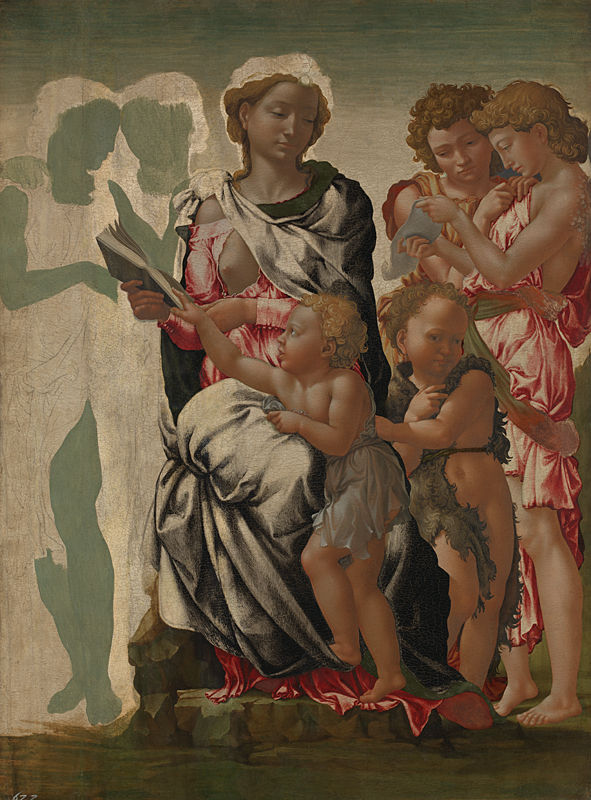
Then on to the second Michelangelo. Past Botticelli’s Aphrodites, and then, alongside a huge, brooding Leonardo, was the second unfinished work by the young Michelangelo, 'The Manchester Madonna' two wonderfully sculptural toddlers, dwarfed by the dark shadows of Leonardo’s Madonna.
What marvels to see in so short a time, assembled here by the magnificence of the Empire at its height. Nowadays, one is endlessly told of the Empire’s darker side. Well, “Power tends to corrupt, and absolute power corrupts absolutely,” as we were told at school — and as we can see today in the face of Putin. But my conversation with the brave Sudanese Bishop the day before had reminded me that the Empire, despite its faults, did bring peace for many years.


Comments