From the Orchard to the Airwaves
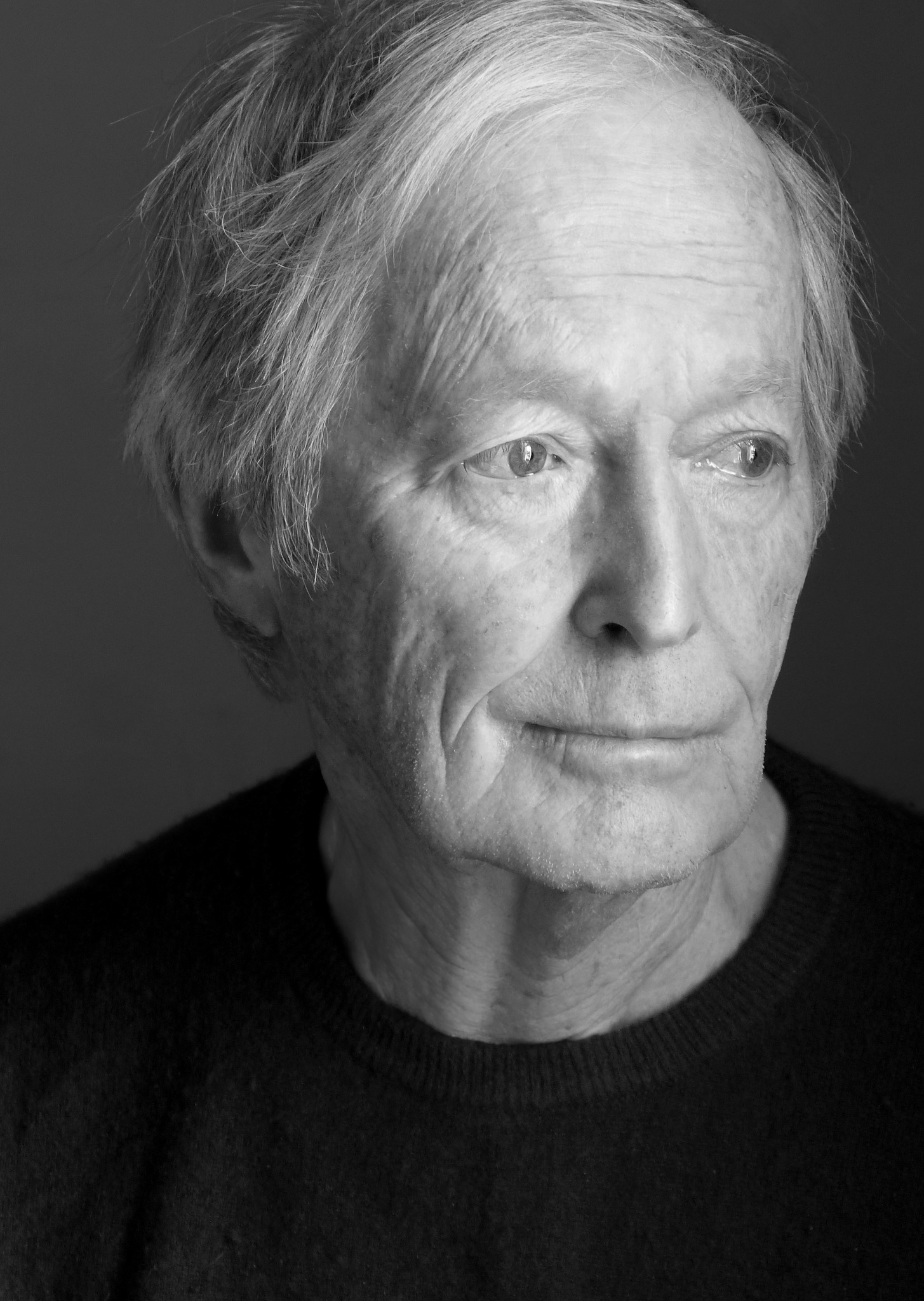
Writing now in my lovely orchard, looking across to a great herd of young dairy cows, beautifully black and white against the grass. The grass is long and wet with dew around my feet, and a watery sun shines through my champion—or supposed to be champion—apple tree.
I planted it 20 years ago, the famous Cox’s Orange Pippin. It is now a towering 30 feet in this famously fertile vale where I’m lucky to live, but sadly this year there are only two or three apples on it. It has been a strange year: extraordinary heat, a long drought, and most of my apple trees have failed, the few which have any apples yielding only a meagre harvest.

Well, here I am trying to write about one of the most tumultuous months of my long life. Almost too much at my advanced age—86 in January. Two different projects have come to fruition at the same time.
Firstly, I had employed a New York book promoter to publicise my book in the USA. My book is very religious and, although all in free verse—I’m still unable to write any other way—it is very traditionally inspired. My favourite poets at the moment are Petrarch, Shakespeare, Michelangelo and the 19th-century French Romantics. Britain seems to me an increasingly irreligious country, while the USA is significantly less so, and probably less woke, so I thought there might be interest there.
I love the great get-up-and-go, the pizzazz of it. I like to think that Chicago, the Windy City, has been a great influence on my life: through the great mathematician John Thompson, and through an inspirational teacher whose books I used in my own teaching. She taught at a university inspired by Saint Vincent de Paul, whose emphasis was on helping the weakest students.
I was very proud of my teaching of a huge first-year class of 300 very disparate students, which previously had had 40 per cent failing. I reduced this to effectively zero, apart from a few dropouts. Her book really focused on answering the questions that students actually have. I published about my teaching methods, with Peter Samuels, my former assistant, when I was 70. The paper, in an important American journal, received a very good response.
I have a love for America, though I am happier now to live deep in rural Wiltshire. Anyway, after some time, the publicist’s efforts yielded fruit in a series of probing podcasts, radio and television interviews this last month. Meanwhile, my efforts to complete the restoration of a beautiful local church, about 1,000 years old and Grade I listed—which means it is of national importance—were also coming to fruition.
After a major restoration of the 700-year-old stone roof a few years ago, teething problems with the structure had persisted. The local people, who had with great effort got this far, all gave up, leaving me holding the reins. The remaining problem was crumbling plaster on the back wall of the gallery, due to damp getting in. The restoration had revealed quantities of fragments of medieval and earlier paintings, so all restoration of the plasterwork has to be done by an expert, at great cost.

During the week of my first big interview, the restorer started on the final stage. A year had been taken up getting the trouble with the roof mended, and the wall was now dried out, so he could at last replaster—with very special mortar, of course.
The day before the interview, as I was preparing for it and a reading I had to give—as a former actor, I have a tremendous routine of preparation—I got a phone call asking me to come urgently and see what he had found. This turned out to be two alarming holes in the wall and, below, more traces of medieval painting. I rushed round, climbed up, photographed the holes and emailed the photographs to the architect, who duly appeared the day after my very wonderful but challenging 30-minute interview for the Donna Seebo Show, from the West Coast of the USA.
Fortunately, the architect is very young, enthusiastic and helpful. He said there was no trouble about filling the holes, but that we had to leave the small section with the paintings for the time being.
Now, two weeks later, it looks great, and I am organising two musical events before Christmas. We couldn’t do this until the gallery wall was mended, as the church is incredibly small, basically Anglo-Saxon.
Maggie Faultless, the internationally renowned violinist who lives in the village, will play at our carol service, and a very successful new group of experienced local singers will give an exciting choral concert in November.
Meanwhile, the success of the first interview led to a television interview last week, filmed for an hour. Quite independently, I had also had another hour-long interview the week before, for a Canadian podcast.
All this has left me rather bewildered. To work out the timeline, I have had to check my diary and phone.
I’m beginning to think I’m a bit old for all this.
I’ll give myself one more year.
Hear me here
It has been a curious pleasure to send my voice across the Atlantic while remaining here in Wiltshire. These conversations have given me time to talk about my poems, my faith and the life from which they have grown.
The Donna Seebo Show
A very wonderful, if challenging, half-hour conversation with Donna Seebo on the West Coast of America. One of the first fruits of my American adventure, and an opportunity to speak about my book and the religious life behind the poems.
In conversation with Sara Troy
An hour-long conversation for Sara Troy’s Canadian podcast, with time to wander a little further into my life and poetry. There is something rather moving about being listened to so carefully, and hearing one’s poems finding a welcome so far from home.


Comments